Ships and Boats of the North
The Viking Ship Museum is working to produce as clear and detailed a picture as possible of the development of the ship in North, from the earliest times to early modern times. But ship sites are not just important as sources concerning the history of the art of shipbuilding – they also provide evidence of the society which produced them. Their construction reflects the intentions and needs which they were built to meet; wear, repairs/refitting, remains of cargoes and even the place where they sank or were broken up reflect the life they lived. Research into a wreck is therefore not complete before the life story of the ship has been written. Each find of a ship tells its own unique story, but the sum of these stories tells the history of society.
With the research series Ships and Boats of the North the Viking Ship Museum contributes to the investigation of the past shipbuilding and seafaring of the North.
Following, presentations of the now published seven volumes of the series.
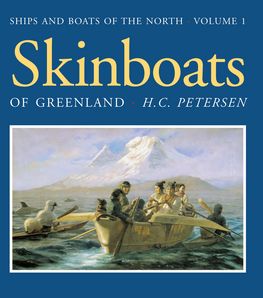
’Skinboats of Greenland’ ved H. C. Petersen. Ships and Boats of the North 1. Roskilde 1986, 214 sider. ISBN 9788785180087. The book is published in collaboration between the Viking Ship Museum in Roskilde and the National Museums in Denmark and Greenland. The book is kindly supported by The Royal Greenland Foundation, The Danish Research Council for the Humanities, Kay Bojesens Fond, A.P. Møller og hustru Chastine McKinney-Møllers Fond til Almene Formål & Tuborg-Fondet.
This book presents the Inuit knowledge of and experiences with the kayak and umiak for posterity.
At the end of the 1920’s most boys were still raised to be hunters as soon as they were able to sit on their father’s and mother’s knees. Holding the small hands of the hunter-to-be, his parents taught him how to row, how to hold the harpoon, and how to throw it. But even then, there were many men who grew up without kayaks. Fishing was beginning to compete with hunting and many men chose rowboats rather than kayaks for that purpose. Fishing also meant jobs on land. In the course of the 1930’s even more kayaks were replaced by fishing dinghies.
Many of the older generation deeply mourned the decline of the kayak. Some regarded the kayak so highly that they preferred to see it vanish completely rather than watch it change into a strange kind of fishing boat, used by men who had none of their forefathers’ skills and traditions. There were others, however, who consoled themselves with the thought that the kayak would be preserved in museums for the future.
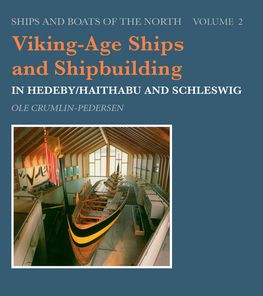
‘Viking-Age Ships and Shipbuilding in Hedeby/Haithabu and Schleswig’ ved Ole Crumlin-Pedersen. Med bidrag af Christian Hirte, Kenn Jensen og Susan Möller-Wiering. Ships and Boats of the North 2. Schleswig & Roskilde 1997, 328 sider. ISBN 8785180300. The book is published in collaboration between the Viking Ship Museum, the National Museum of Denmark and Archäologisches Landesmuseum der Stiftung Schleswig-Holsteinische Landesmuseum, Schloss Gottorp. The book is kindly supported by Kulturstiftung des Landes Schleswig-Holstein, Danish National Research Foundation, Danish Research Council for the Humanities.
This book investigates the finds of ships and boats as well as objects related to these from Viking-Age Hedeby. Hedeby was not only an important centre in the international trade-network of the Viking-Age, but also a building-site for specialised ships and boats of different standards and for different purposes.
Hedeby was a melting pot for impulses from many directions. Thus, it would be expected that influences from all these sides would be traceable in the archaeological evidence for the building of boats and ships. To some degree this is indeed the case, even though the overwhelming part of the evidence seems to represent the shipbuilding traditions of the Danes.
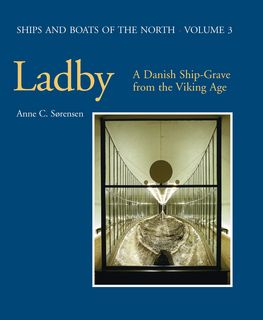
"Ladby. A Danish Ship-Grave from the Viking Age by Anne C. Sørensen. With contributions by Vibeke Bischoff, Kenn Jensen and Peter Henrichsen. Ships and Boats of the North 3. Roskilde 2001, 293 pages. ISBN 8785189440. Published by the Viking Ship Museum in collaboration with the National Museum of Denmark and Kertemindeegnens Museer. The book is kindly supported by: The Danish National Research Foundation, The Danish Research Council for the Humanities, Ingeniør N.M. Knudsens Fond og Møllerens Fond.
The ship-grave from Ladby is one of the major ship-graves, in the category which also includes the boat chamber-grave from Hedeby and the ship-graves from Oseberg, Borre, Gokstad and Tune in South Norway, all built in the 9th and 10th centuries. The grave, which is situated in an ordinary burial site from the Viking Age, contains an abundance of grave-goods consisting of both objects and animals, and it was previously dated to the first half of the 10th century on the basis of the find of a gilded link of bronze for a dog-harness decorated in Jelling style. The grave was subsequently subjected to extensive disturbance, and since there was apparently no trace of the dead person or persons, the disturbance has been interpreted as the result of translatio, i.e. removal from a heathen to a Christian grave.
The queries concerning the ship-grave from Ladby concern e.g. the construction of the grave, the precise characteristics of certain parts of the artefacts found, the positioning of the body or bodies, the dating of the grave and the significance and date of the disturbance. Then there is the question, at a higher order of significance, of the socio-historical importance of the location of the find. How should this find be understood in relation to the burial site immediately alongside it, to the local area, to the island of Funen (Fyn) and to the rest of Southern Scandinavia and the Kattegat area as a whole in the period around 900?
The book is providing answers to these questions. By conducting various analyses taken of both the artefact material and the bone material (x-ray photographs, and fluorescence analysis, accelerator dating, wood-anatomical and anthropological analyses and textile, fibre and rope analyses.) In parallel a comparison was made of this ship-grave with other similar contemporary finds, and with Viking-Age graves in general, chiefly from the South Scandinavian region. In order to achieve a deeper understanding of the background for the existence of the ship-grave, an investigation was carried out of the burial site where the ship-grave is situated and of the possibly associated settlement, as well as of the settlement-development in the local area from around the time of the birth of Christ to the early Middle Ages.
Complexity is the most conspicuous aspect of the ship-grave from Ladby, which at the same time displays references to travel activity and contains features which can be explained in the local context. The contents show connections internally on Funen, and also across the whole Scandinavian region, and at the same time reflect association with an elite milieu characterised by a homogeneous demonstration of wealth and power. North-east Funen has a central position on Kattegat and thus in relation to the sea-travel routes used inter-regionally and super-regionally. Kerteminde Fjord and Kertinge Nor were of great significance for access to and from Odense, and the dead man in the ship-grave may have been the controlling authority in this context. With this background we can reach a greater understanding of the dead person in the ship-grave from Ladby, for whom the ship probably had overwhelming significance for the maintenance of a ruling position in Viking-Age society.
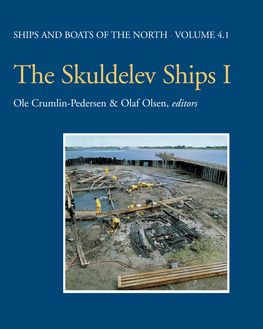
'The Skuldelev Ships I. Topography, Archaeology, History, Conservation and Display', by Crumlin-Pedersen, Ole & Olaf Olsen (eds) 2002: Ships and Boats of the North 4.1. Roskilde, 360 pages. ISBN 8785180467. Published by the Viking Ship Museum and the National Museum of Denmark. The book is kindly supported by: The Danish National Research Foundation og The Danish Research Council for the Humanities.
This book presents the accumulated results of the work on the Skuldelevfind, a barrier from the 11th century in a channel in Roskilde Fjord, Denmark, containing five ships of varying type and provenance.
The geological history of Roskilde Fjord is investigated in detail, which is necessary for understanding the topographical situation at Skuldelev, where the ships were sunk in one of the channels in the fjord, Peberrenden.
Following is an account of the history of the excavation, the documentation methods employed and the conservation conducted, and finally the display of the ship-finds. The books ends with a detailed analysis of the five ships, based on the surviving part of wrecks, and conclusions drawn about the age of the individual ships, their origin, function, and history are further contextualised.
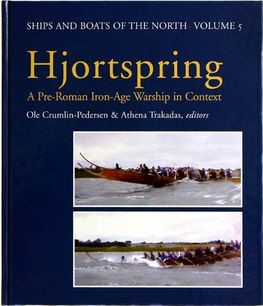
'Hjortspring. A Pre-Roman Iron-Age Warship in Context', by Crumlin-Pedersen, Ole & Athena Trakadas (eds) 2003. Ships and Boats of the North 5. Roskilde, 293 pages. ISBN 8785180521. Published by the Viking Ship Museum and the National Museum of Denmark. The book is kindly supported by: The Danish National Research Foundation og The Danish Research Council for the Humanities.
The subject of this monograph is a weapon-offering from the fourth century BC found in Hjortspring Mose on the island of Als in southern Jutland. Special attention is paid here to the originally ca 19 m-long plank-built boat, which forms the central element of the find. The excavation and the following conservation, restauration and display of the boat-find is presented.
The book then deals with the building of a full-scale reconstruction of the boat and the subcequently test sailings conducted on board the reconstruction. Finally, the boat-find's ship historical and Bronze and Pre-Roman Iron Age context is investigated.
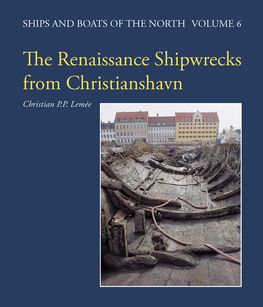
'The Renaissance Shipwrecks from Christianshavn. An archaeological and architectural study of large cargo vessels in Danish waters, 1580-1640', by Christian P.P. Lemée. Ships and Boats of the North 6. Roskilde, 271 pages. ISBN 8785180343, published in May 2006 by the Viking Ship Museum in collaboration with the National Museum of Denmark. The book is kindly supported by: Nordea Danmark Fonden, A/S Det Dansk-Franske Dampskibsselskabs Understøttelsesfond af 1950, Augustinus Fonden, Københavns Skipperforening, Konsul George Jorck og hustru Emma Jorck’s Fond og Farumgaard-Fonden.
This book presents the results of an archaeological and architectural study of shipbuilding methods in north-west Europe between 1580 and 1640, based on the analysis of the excavated archaeological remains of eight ships and boats in the former harbour of Grønnegaard in Copenhagen.
The results of the archaeological excavations, and the following analyses of the largest wrecks, show that the shipbuilding methods used by the shipbuilders in the northern part of Europe, were totally different from those practised in the southern part, often designated as Iberian-Atlantic.
The historical sources indicate a strong influence of the Iberian-Atlantic method on Danish State-controlled shipbuilding (with Scottish and English shipbuilders using the English method, associated with the skeleton-based concept). In contrast with that, the archaeological sources provide information pointing towards the fact that private shipbuilding used another method.
Though the Crown regularly employed shipbuilders called in from across the whole country, these seem to have been able to work in both techniques, but as is indicated by later sources, the private shipbuilders still practised a Dutch-inspired shell-based shipbuilding up to the late 19th century.
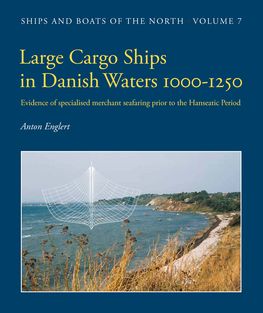
'Large Cargo Ships in Danish Waters 1000-1250. Evidence of specialised merchant seafaring prior the Hanseatic Period', by Anton Englert. With contributions by Ole Crumlin-Pedersen, Aoife Daly, Tinna Damgård-Sørensen, Carsten Jahnke, Michael R. Kristiansen, Hans Joachim Kühn, Ole Magnus & Susan Möller-Wiering. Ships and Boats of the North 7. Roskilde 2015, 378 pages. ISBN 978-87-85180-53-7. Published by the Viking Ship Museum. The book is kindly supported by: Dronning Margrethes og Prins Henriks Fond, The Danish National Research Foundation, Farumgaard-Fonden.
This volume presents the archaeological evidence of large cargo ships in Danish waters between 1000 and 1250 and asserts that they are an important element, and indicator, of specialised merchant seafaring in medieval Denmark prior to the Hanseatic Period.
The large cargo ships were most likely owned by powerful members of Danish society. The owners of these large cargo ships must have been as outstanding in wealth and social rank as their ships were outstanding in size. Regarding theories of a ‘Europeanization’ of peripheral areas around the formerly Frankish core of Latin Europe in the High Middle Ages, the mere existence of a class of large Danish-built, Nordic style cargo ships of 50-60 tons cargo capacity in the 11th and 12th centuries may be seen as an element of this transformation, while at the same time maintaining cultural identity, tradition and political independence.
The appearance of the seagoing cog in the Danish Kingdom in the middle of the 12th century marks the beginning of a highly dynamic and prosperous period, where Denmark under the kings Valdemar, Canute VI and Valdemar II emerged as a “fairly Europeanized power” within the semi-periphery of a ‘Catholic World-system’. Denmark would go on to concentrate and consolidate its secular and ecclesiastical power, taking possession of the southern Baltic Sea shore, Lübeck and northern Estonia, and thereby fully exploiting its pivotal location between the transport zones of the North and Baltic Seas.
Future archaeological research may shed more light onto the early history of Hanseatic seafaring in Danish waters and the kind of ships which were used by Danish and German merchants in the 13th century. In order to examine the range and significance of Danish and German trade as well as the seafaring activities of the other Baltic Sea nations in the Middle Ages, it is vital to encourage and strengthen the professional study and preservation of maritime heritage in the entire Baltic Sea area. The present era of European integration and modernisation offers unprecedented potential for both preservation as well as destruction of heritage.
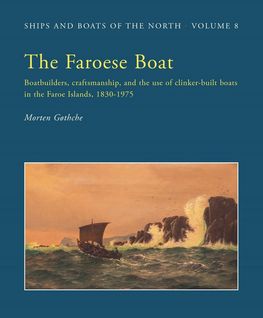
‘The Faroese Boat - Boatbuilders, craftsmanship, and the use of clinker-built boats in the Faroese Islands, 1830-1975’ by Morten Gøthche. Ships and Boats of the North, Volume 8. Roskilde 2023. 361 pages. ISBN 978-87-85180-76-6. The book is published with support from: Boghandler Henning Clausens Fond, Dansk-Færøsk kulturfond, Hiddenfjord, Konsul George Jorck og Hustru Emma Jorck’s Fond & Mentanargrunnur Landsins.
The Faroese boat has been developed and adapted to the special sailing conditions around the Faroe Islands, which consist of strong currents and sudden gusts of wind. The boat was primarily utilised as a rowing boat but could also be powered by sail. It was built in different sizes, and the boatbuilders always had to rely on materials imported from abroad with the additional use of driftwood for various boat components.
This volume presents the building process and usage of the Faroese boat. It shows the boat’s great importance to Faroese society, as it was used for fishing and transporting people and goods. The building process, craftsmanship, and seamanship are examined in great detail, and the maritime history of the Faroese Islands from the Viking Age to the 1970s is presented.
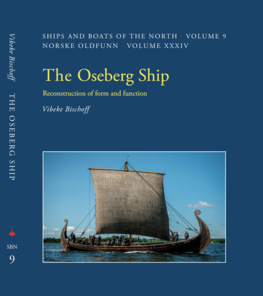
Ships and Boats of the North, Volume 9 & Norske Oldfunn, Volume XXXIV. Roskilde 2023. 294 pages. ISBN 978-87-85180-77-3. The book is published with support from: Dronning Margrethes og Prins Henriks Fond, Eilif Holtes Allmennyttige Fond, Landsdommer V. Gieses Legat og Slots- og Kulturstyrelsen.
The Oseberg Ship from AD 820 is the world's best-preserved Viking-Age ship-find, lavishly decorated with carvings at its bow and stern. It is also the oldest Nordic ship-find with clear traces of sail and rigging. However, the ship's apparently flimsy construction has been debated ever since it was excavated in 1904 in a burial mound just northeast of Tønsberg, Norway. Was the Oseberg Ship built solely as a non-sailing symbol, to project power and wealth? Was it only built for sailing in near-shore and calm waters? Or was it a technically superior ship, built for ocean sailing in all types of weather? In 1987, a full-scale reconstruction of the ship, based on the original ship as it stands today in the Viking Ship Museum in Oslo, was found to lack crucial sailing characteristics, and it sailed itself underwater soon after it was built.
This volume presents a thorough re-analysis of the Oseberg Ship to determine its construction and performance. Extensive measurements and scans of the original ship, and digital- and scaled models form the basis of this study, which presents a completely new reconstruction. The resulting model and a new full-scale reconstructed ship reveal that the Oseberg Ship was a well-crafted, strong construction, executed at a very high technical level. The Oseberg Ship was not only a magnificent symbol of power and wealth, but also a unique sailing ship – a decisive representative of Nordic shipbuilding and seafaring in the Viking Age.