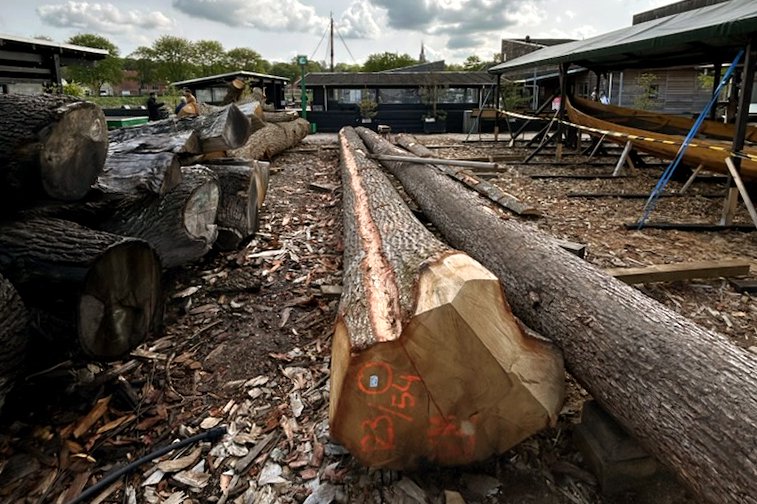
Work will begin on Monday 11 May at around 10 a.m., and the boatbuilders expect that splitting the trunk into two halves, one of which will subsequently be divided into quarters, will take two days.
The material from this oak trunk will be used for stringers, the internal longitudinal reinforcements in the hull of the 17 metre warship Skuldelev 5 reconstruction that the boatbuilders are currently working on.
Straight splitting, also known as plank splitting, is a slower process than the more common radial splitting method that boatbuilders typically use when cleaving oak trunks into planks for shipbuilding.
Before the actual splitting can begin, the trunk must be carefully prepared, as straight splitting requires the boatbuilders to exert greater control over the split.
“We split along the natural grain as we usually do, but we ‘manipulate’ the split so that the trunk cleaves more straight,” explains Martin Dael, head of the boatyard.
“That is why we call it straight splitting, in contrast to ordinary radial splitting, where the split follows its own course.”
Along the entire length of the trunk, the boatbuilders first cut two grooves diagonally opposite each other. These prepared grooves originate from the felling crack at the root end of the tree, which is where the trunk most naturally tends to split.
This requires a high degree of precision, as the grooves must guide the split and ensure that the trunk divides correctly.
Once the grooves are ready, the splitting itself begins. The boatbuilders drive wedges into the two grooves from either side of the trunk, gradually opening it up.
This stage of the work may extend over both Monday and Tuesday, depending on how the wood behaves. Once the trunk has been split into two halves, the boatbuilders divide one of them into two quarter sections that will become the raw blanks for the two long stringers. The other half is set aside for a future project.
Martin Dael is, however, confident that they will achieve two straight halves from the long oak trunk.
“We debarked the trunk on Wednesday and could see that the grain runs very straight and shows almost no twisting. I therefore have high hopes that we will obtain good material for the ship’s stringers.”
The straight splitting process is a living example of the Viking Ship Museum’s work with experimental archaeology and traditional boatbuilding craftsmanship, where experience, collaboration and a deep understanding of the material are essential for expanding our knowledge of past methods and techniques.