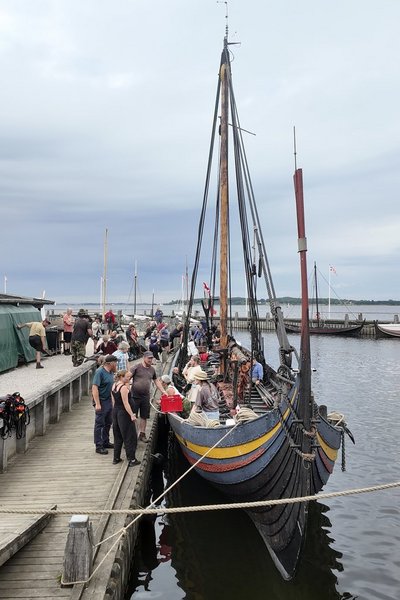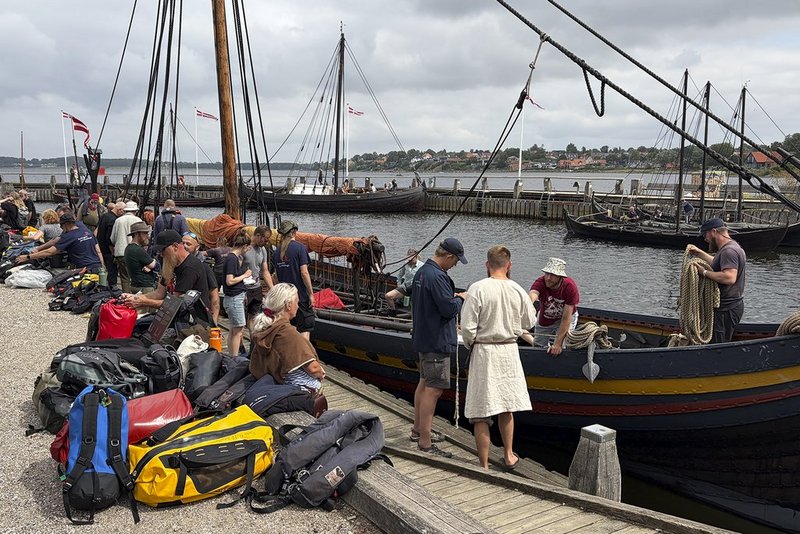
This year's summer voyage with the Sea Stallion from Glendalough has now been successfully completed. From 18 to 31 July, the ship sailed through Roskilde Fjord and Isefjord with 45 crew members on board, and the days alternated between sailing, training, harbour life and community.
Along the way, the crew were reminded of one of the most important realities of Viking ship sailing: nature determines the pace. Strong northerly winds, thunderstorms and summer storms repeatedly altered the plans, while other days brought excellent sailing conditions and good speed through the water. On the passage between Orø and Rørvig, the Sea Stallion reached speeds of up to nine knots, but just as important as those fast nautical miles was the ability to wait when the weather demanded it.
Life on Board
The constant interplay between sailing and waiting is an important part of the experience of sailing the world's largest sailing reconstruction of a Viking ship. When the wind kept the ship in harbour, life on board did not stand still.
The crew trained manoeuvres, practised seamanship and worked on skills such as bracing the sail aback, reefing the sail, and manoeuvring the 30-metre-long longship in changing conditions.
At the same time, harbour stays in places including Frederikssund, Orø and Rørvig provided opportunities to meet curious visitors, who were able to get close to the ship and try their hand at the oars. In the evenings, tents were pitched, meals prepared, stories shared and new friendships formed around camp life on the quay.
Experiencing History First-Hand
For both new and experienced crew members, the summer voyage provided an opportunity to experience Viking ship sailing for themselves. On board, sailing, navigation, weather assessment and cooperation became part of everyday life.
The crew felt the force of the wind, learned the ship's characteristics and gained experience of the challenges that seagoing travel has presented for centuries. Several of this year's participants were new to the ship, but quickly became familiar with both the vessel and the community through work on deck, at the oars and under sail.
The following is a diary of this year's summer voyage, highlighting some of the experiences, challenges and everyday moments that shaped the crew's journey through Roskilde Fjord and Isefjord.
Extracts from the Voyage Diary
18 July | Roskilde
The final preparations were completed before the Sea Stallion and her 45 crew members could set course for this year's summer voyage.
"We warped the Sea Stallion beneath the bridge and rigged her ready so that she could set out on this year's summer voyage," the boat guild reported shortly before departure.
The morning was spent completing the final preparations and introducing new crew members. Once the provisions had been loaded and the newcomers had been introduced to life on board, the boat guild rowed the ship out of the harbour and let the wind and the power of the oars carry them through the first nautical miles of the voyage along the narrow waters of Roskilde Fjord.
18 July | Østby Harbour
The first evening of the voyage was spent in Østby Harbour.
And it is not simply a matter of going ashore and relaxing once the day's sailing is done. Tents must be pitched, dinner prepared and a campsite established for the 45 crew members.
But when the day's work is over, the pace slows. Stories are shared, new friendships are formed and the sense of community around the ship grows stronger.
"These are the hours that make a voyage about more than just sailing," the boat guild writes on its Facebook page.
Nautical miles and destinations are an important part of the journey, but the community surrounding the ship is just as important.
19 July | Frederikssund
The weather reminded the crew who is in charge.
Only a short sail was possible before forecasts of strong northerly winds and thunderstorms led the Sea Stallion to change course for Frederikssund.
"The forecast promised strong winds and thunderstorms, and when the weather speaks, you listen. The wind decides, today just as it did 1,000 years ago," the boat guild writes on Facebook.
For this situation is not very different from what the Sea Stallion's historical predecessor experienced almost a millennium ago. Then, as now, seafarers had to arm themselves with patience and wait for favourable winds and weather before continuing their journey.
And when the weather failed to improve the following day, it became a lay day. There was no need to pack equipment and tents, and there were no rowing commands or departure times. On the voyage's first lay day, the crew had to find the rhythm of life ashore, spending their time maintaining maritime skills, taking part in light theoretical instruction and carrying out the practical tasks that keep the community functioning.
And weather forecasts were checked.
For no matter how pleasant life in harbour may be, everyone hopes that the wind will soon become favourable enough to put more nautical miles beneath the keel.
23 July | Lynæs and Orø
But things did not quite work out that way.
The wind continued to prove unpredictable, either arriving in strong, gusting northerlies or failing to appear at all. The dream of covering many nautical miles was therefore temporarily set aside in favour of reaching the northernmost part of the fjord, where the northerly wind could be used to advantage on the journey south through Isefjord.
Finally, on 23 July, the crew was ready to head for Orø.
The day began with a somewhat unusual harbour manoeuvre out of Lynæs. Quite simply, there was not enough room to row the Sea Stallion clear of the harbour, and an alternative solution had to be found. With help from local people, the ship got safely underway, and yet another new solution could be added to the crew’s growing experience.
South of Lynæs Sand, Isefjord opens up into the perfect setting for a thorough training sail. There is enough room to get the ship up to speed, yet not so much room that there is no need to turn frequently and decisively. When a ship sails long distances, there can be long stretches between manoeuvres, but in the fjords the crew must stay alert at all times when the ship is under sail. Every turn strengthens the teamwork and coordination required from bow to stern aboard the 30-metre-long ship.
"Practice makes perfect, and it is a pleasure to feel how crew and ship work better and better together with every manoeuvre," writes the boat guild following the training sail.
Later in the day, the Sea Stallion arrived at Orø. The great longship quickly attracted attention in the harbour, where both children and adults stopped by to experience the vessel at close quarters. Several visitors were also given the opportunity to try the oars for themselves and gain a personal insight into life on board.
27 July | Orø to Rørvig
After several rewarding and educational days on board, the Sea Stallion arrived in Rørvig on 27 July. The passage from Orø proved to be a lively one:
"We began with a fantastic sail from Orø to Rørvig, reaching speeds of up to 9 knots. It was a wonderful voyage with great speed through the water," the boat guild writes on Facebook.
The plan had been to continue out into the Kattegat, but the weather had other ideas. Rather than battle wind and waves, the crew chose to remain in Isefjord. Once again, the open waters of the fjord became a training ground, and the guild had the opportunity to practise some of the manoeuvres they do not use very often, including bracing the sail aback, which the crew refers to as their "emergency brake".
When the sail is braced aback, the ship slows down. Some sailors also refer to this manoeuvre as heaving to. The yard that carries the large square sail is turned using the braces, the ropes attached to either end of the yard, so that the wind is partially caught on the forward side of the sail. In this way, the ship's forward motion is counteracted. The vessel loses speed and can be held more or less stationary, or kept under control, while the crew waits, takes bearings, or carries out a task.
The crew also practised reefing the sail, a manoeuvre used when the wind becomes too strong. On the Sea Stallion's large square sail, this means that part of the sail can be tied up either along the lower edge or up against the yard, reducing the sail area. This allows the ship to continue sailing safely even when conditions become more demanding.
28 July | Rørvig
Then the wind finally made its presence felt, and the Sea Stallion rode out the summer storm in harbour.
Lay days are part of Viking ship sailing. The ships have no engine, and therefore wind and weather are crucial in determining when it is possible to continue the voyage.
Waiting for the right wind is therefore part of the voyage itself. Viking Age longships could cover great distances quickly when conditions were favourable, but when the wind was against them, crews would often wait for better conditions. Pressing on against wind and sea consumed both time and energy and placed unnecessary strain on ship and crew alike. Only when the weather turned favourable again would the journey continue. That patience was a prerequisite for long-distance sailing in the Viking Age.
The same was true of the great fleets of the eleventh century. In connection with the campaigns of Cnut the Great, the skald Þórarinn loftunga describes how ships assembled at Egersund and waited for favourable winds before the next stage of the voyage could begin.
In Rørvig, the waiting time was put to good use. While the wind kept the Sea Stallion in harbour, life on board and on the quay continued. The harbour was full of sailors, and the crew had ample opportunity to talk with the many curious visitors who invariably gather whenever the ship is in port.
The windy weather also brought a final end to hopes of reaching the open waters of the Kattegat, allowing the harbour days instead to be spent planning the journey home.
30 July | Østby Harbour
All roads lead to... Østby.
Østby Harbour is one of the small fjord harbours where traces of the old fjord fishing tradition can still be seen. The harbour was built for local dinghies and small fishing boats and has for generations served as a natural meeting place for people living along the fjord.
On the voyage back to Roskilde, the small harbour once again welcomed the fjord’s longest wooden vessel, this time as the final stop of the summer voyage.
As evening fell, dark clouds gathered overhead, and beyond the horizon the night sky was illuminated by a spectacular display of lightning. From the quay, the crew watched nature’s own light show, a reminder of the forces that had shaped the entire summer voyage.
31 July | Museum Harbour
On the final day of the voyage, the wind was finally on the side of ship and crew. A north-westerly breeze provided perfect conditions for passing through the narrow channel by Eskilsø and into the inner waters of Roskilde Fjord.
At 9 a.m., the ship was packed, the crew was on board, and the final stage of the voyage could begin.
The crew enjoyed the favourable conditions and spent the day undertaking training sails. The final lunch of the voyage was eaten on board before the ship, somewhat wistfully, set a course for the Museum Harbour.
At 6 p.m., the Sea Stallion glided majestically into the harbour. Only a few rowing commands were needed before the ship lay safely alongside the quay.
Thank you for this voyage, and until next time.
Remember that the boat guild community is open to all, and there is always room for new members who wish to sail on the terms of the past.
Facts: The Boat Guilds at the Viking Ship Museum
The Viking Ship Museum's boat guilds are volunteer communities whose members sail, maintain and help interpret the museum's reconstructions of historic vessels.
As a guild member, you become an active part of the work of keeping traditional maritime crafts, sailing practices and seafaring traditions alive through practical experience. The activities of the guilds range from sailing and voyages to ship maintenance, training, public engagement and social events.
You can read more about the museum's boat guilds at laugnet.dk.
One of these guilds is the Sea Stallion Boat Guild, which has around 200 members of all ages, backgrounds and experience levels. The guild is responsible for sailing, maintaining and communicating the story of the Sea Stallion from Glendalough, the world's largest reconstructed Viking ship. At the same time, the guild works closely with the Viking Ship Museum on experimental archaeological investigations into the ship's sailing characteristics.
You can find more information about the Sea Stallion Boat Guild at laugnet.dk.
No previous sailing experience is required to become a member. New members are trained through participation in guild activities and become part of a community where learning, cooperation and hands-on experience are central elements.
The boat guilds typically sail on weekday evenings and at weekends from April to October, as well as on longer voyages during the Whitsun holiday and the summer holiday period.
Those interested can read more about the various guilds and apply for membership via Laugnet.
If you would specifically like to learn more about the Sea Stallion Boat Guild, the guild can be contacted at havhingsten@live.dk or through the chairman, Anders Brendstrup, on +45 28 93 13 26.