Exposing the past
The Viking ships are sunk in Peberrenden, the most direct sea route to Roskilde. Along with rock-filled boxes, piles and floating barrages, they form a large, coherent defence system that can close off the fjord.
The stems and railings from the upper-most ships can bee seen on the surface, visible to anyone who approaches. The barrage keeps hostile fleets away from Roskilde.
On thousand years later, from 1957 to 1959, the National Museum is undertaking Denmark's first underwater excavation of what the archaeologists believe is a single Viking ship in Roskilde fjord.
But gradually, more and more ships appear. All of the iron rivets are rusted away and the wrecks form a giant puzzle - tens of thousands of ship parts that have to be retrieved one by one. Many of the ship parts are so fragile that they cannot be exposed and excavated under water. The barrage has to be drained.
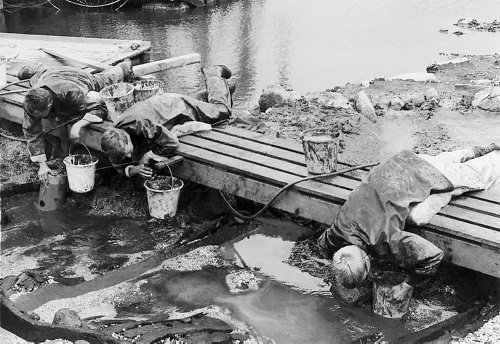
Day and night, pile drivers and welders work to surround the barrage with a cofferdam. On 6 July 1962 the pumps are turned on, and the barrage gradually appears. It lies like a tonque of land across the sailing channel. The excavation team has twenty weeks to work their way down through the sand, rocks and mud.
To protect the soft, waterlogged ship timbers, the archaeologists work from a system of bridges placed above the barrier. From here, tons of mud is removed in buckets, and ship parts are excavated by bare hands. By 8 September all the ships are exposed, and the achaeologists can finally see the fantastic extent of the find. They believe no less than six ships are distinguishable.
By 17 October 1962 all the ship parts were brought up, the pumps were turned off, and the work team left the excavation. Over the coming weeks, the cofferdam and other technical equipment were also removed. Roskilde Fjord returned to its normal state - but without the five Viking ships.
Olaf Olsen and Ole Crumlin-Pedersen, 1969
The excavation is followed by years of patient work measuring, drawing and preserving the ship parts. Two of the ships turned out to be one and the same, with an impressive length of 30 metres. Six Viking ships became five.