From wreck to reconstruction
We regard a ship find as a source of extensive and complex cultural-historical knowledge.
Søren Nielsen, Head of Maritime Crafts, Reconstruction and Public Activities, 2008
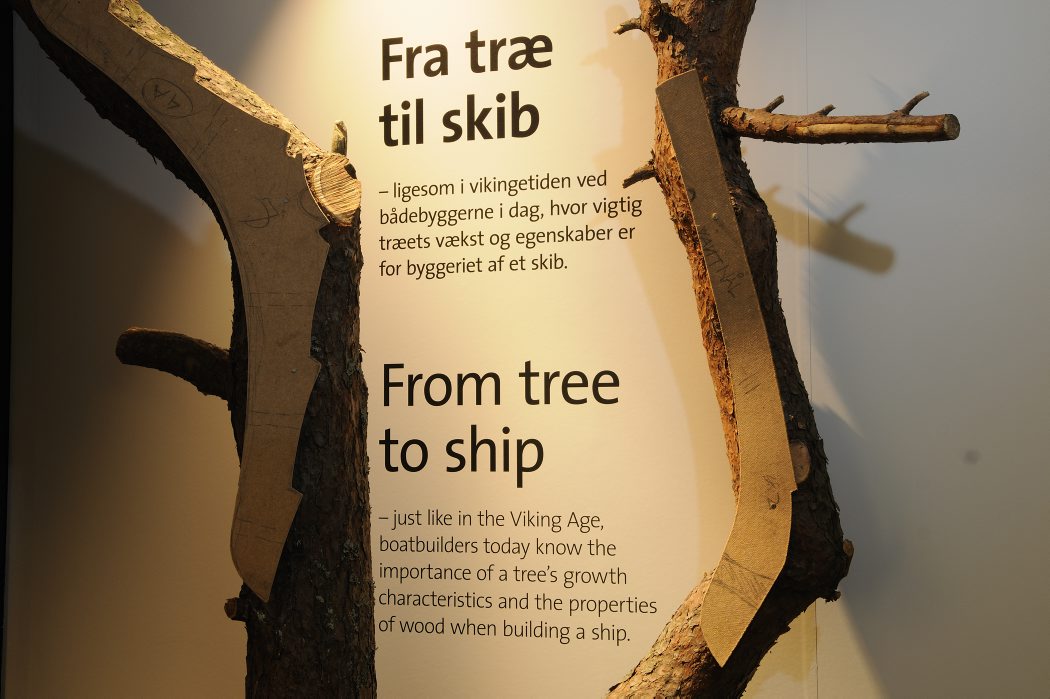
The five Skuldelev ships were built and used by people who left innumerable traces in the vessel: The forms of the ship tell us about their function, the water they were built to sail, and the boat owners' and boatbuilders' wishes for their sailing capabilities. The wood fibre structure reveals how certain parts of the tree were used to build specific ship parts. And tool marks tell us how the boatbuilder used axes, planes and drills.
The boatbuilders at the Viking Ship Museum build a ship using copies of Viking Age tools and corresponding materials and techniques. The shape of the hull is reconstructed based on the preserved parts of the original ship. The missing parts are reconstructed using other ship-finds and Viking Age ship motifs, as well as more modern traditional Nordic clinker-built boats, which hark back to Viking Age ship design. The process is called experimental archaeology.
The method requires co-operation between people from different backgrounds. Archaeologists, historians, marine architects and engineers, boatbuilders and sailors all contribute with specific knowledge and experience, and therefore ask different questions.
The work gives us an idea of the extensive resources required to build ships ind the Viking Age. The study of ships bring us closer still to discover surprising details, and for each new reconstruction, we learn more about the importance of ships in Viking Age society.
It is not about finding one answer. The finished reconstructions are not definitive truths, but hypotheses. They represent suggestions of how ships may have looked 1,000 years ago.