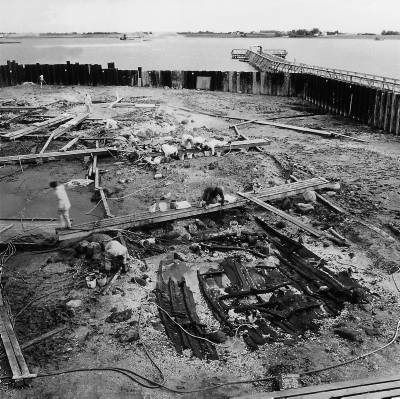
The Viking ships are almost lost
The Skuldelev find opened the door to the rich archaeological treasury lying on the seabed along the Danish coats.
Ole Crumlin-Pedersen. Arcaheology and the Sea - in Scandinavia amd Britain, 2010.
In the twentieth century, extensive dredging for oyster shells, used in chicken feed, has changed the underwater landscape at the bottom of Roskilde Fjord. Old sailing channels and other historical relics have disappeared, and the Skuldelev ships almost suffered the same fate. In 1960, archaeologists managed to stop the dredgers just 60 metres from the barrage.
With the discovery of the Skuldelev ships, interst arose in preserving submerged Stone Age settlements, barrages and historical shipwrecks. In 1962, Olaf Olsen arranged a meeting with the then Minister of Culture, Julius Bomholt. The meeting resulted in the first Danish law for protection of historic shipwrecks, amongst other things, passed in May 1963.
Today, the Viking Ship Museum is responsible for the maritime archaeology of Zealand and its islands, and cooperates with developers of planned harbour expansions, new pipelines installations and offshore wind turbine developments, which can pose a threat to underwater achaeological sites.
The maritime archaeologists examine and excavate finds from all historical periods - from Stone Age settlements to shipwrecks from Second World War.